|
|
|
Judge rules against police taping lawyer
Legal Business |
2007/04/28 01:49
|
A judge has ruled that there was not enough probable cause to allow recording of a conversation between an undercover police officer and a defense lawyer as part of an obstruction of justice investigation. Some attorneys across the state were concerned about the case, worried it could impinge on their ability to effectively represent their clients. The matter sprang from a domestic assault case involving defendant Terry Russ. After police had trouble locating witnesses in the case, including the victim, they initiated an obstruction of justice investigation. Russ eventually entered into a plea agreement. But because of telephone conversations between Russ and his mother, Brattleboro police apparently suspected that his lawyer, Eileen Hongisto, may have been involved in the matter as well. Police obtained a warrant allowing an undercover detective to call Hongisto and, taping the conversation, pose as a witness asking if he should testify. No charges were ever filed against Hongisto over the case. This week Judge Karen Carroll of Windham District Court ruled that warrant should never have been issued and ordered that the tapes of the conversation be returned to Hongisto. "A review of the affidavit in support of the search warrant in this matter reveals that it lacked the necessary probable cause to support the belief that Ms. Hongisto was involved in criminal activity or that evidence of a crime would be obtained through a phone call to her by an undercover police officer," according to the ruling. The judge who issued the warrant, Katherine Hayes, recused herself from ruling on Hongisto's motion that sought the tapes of the conversation. "I feel totally vindicated," Hongisto said Friday. "I hope by going as far as we did go with this that we protected defense attorneys." "I knew I hadn't said anything wrong or done anything wrong, but I needed to have the public know that as well," she said. Hongisto said she is not sure if she will file a civil lawsuit in the matter. "I haven't thought that far ahead at all," said Hongisto. Windham County State's Attorney Dan Davis said he did not see the warrant request before it was presented to the judge originally and his office will not appeal the decision reached by Judge Carroll on Tuesday. "We have followed the judge's direction and returned the audio tapes to attorney Hongisto," he said. Allegations of a crime must be investigated whether the accused is a lawyer or not, Davis said. "If, in fact, there is an allegation that someone may be involved in violating the law, that matter ought to be looked into," he said. But the investigation and tape recording of a conversation with a defense lawyer is unusual, he added. "This is a very rare event," he said. "This is the only time I am aware of in my 32 years in law enforcement in the state … that this has happened." Defender General Matthew Valerio said the judge's decision this week was the correct one. "It vindicates Eileen Hongisto and it frankly supports my opinion and the opinion of many defense counsel that there wasn't probable cause to support the warrant," Valerio said. "I never got the sense that people were going to practice law defensively" because of the case, he said. "It's not a dimmer switch. You either do it or you don't do it." As for Hongisto, she said she will continue on in her general law practice. The danger in the case for the practice of defense lawyers was that they would be blocked from advising their clients about the status of their cases, said Hongisto, who graduated from Vermont Law School and worked as a public defender before going into private practice. "You wouldn't be able to give accurate and sound legal advice to your client," she said. "If you are not allowed to discuss those options with your client, how can they make an informed and voluntary decision." |
|
|
|
|
|
|
Law firm sued over forgery by attorney
Legal Business |
2007/04/27 03:50
|
A prominent Denver law firm is being sued after one of its attorneys forged a federal judge's signature on a legal document.
The forgery allowed one of Faegre & Benson's clients to obtain a loan and pay the firm for work, according to the lawsuit filed Tuesday in U.S District Court in Colorado. The attorney, Mark W. Fischer, admitted in a two-page letter that on April 25, 2005, that he "fabricated a false document which purported to be an order" signed by Judge Philip -Figa to release a lien against his client's property. The lien had been entered against Judy Heumann after Infant Swimming Research won a breach-of-contract lawsuit against her. "I accept full and sole responsibility for any and all improper conduct associated with this matter," Fischer wrote in the letter to federal magistrate Michael E. Hegarty. Fischer said he asked Heumann to give $90,000 to his firm to deposit in court as bond for the release of the lien. Fischer said the money was never deposited. After the lien on her property was released, Heumann obtained a loan from Countrywide Home Loans. The state Supreme Court suspended Fischer on April 11 and he faces a disciplinary hearing. Faegre & Benson partner Dave Stark said the firm learned of Fischer's conduct hours before he sent the letter April 9. Fischer resigned the same day. "What Mr. Fischer described in his letter is inconsistent with the way Faegre & Benson has practiced law for over 100 years," Stark said. Fischer declined to comment. The company that sued Heumann is now suing Fischer and Faegre & Benson, saying they "failed to properly supervise Fischer." The suit also names Heumann. "We believe that she had involvement and had notice of the fabrication of the (order) prior to March 28, 2007, when he found out about the fabricated order," said Douglas Jaffe, an attorney for Infant Swimming Research Inc. Fischer, in his letter to the court, said Heumann was unaware the signature was forged.
|
|
|
|
|
|
|
McCullough quits County Council race, leaves law firm
Legal Business |
2007/04/25 00:17
|
Upper St. Clair attorney Charles McCullough, under scrutiny for his management of a widow’s trust fund, has dropped out of the race for an at-large Republican seat on Allegheny County Council, his former campaign coordinator said today. McCullough also no longer works for Downtown law firm Eckert, the firm’s CEO, Tim Ryan, confirmed this afternoon. "He is not employed by, nor associated with, Eckert Seamans," said Ryan, who declined further comment. Ryan said the firm is still examining how McCullough helped manage a fund for Shirley H. Jordan, 90, of Upper St. Clair, that donated $10,000 each to a judicial candidate, three council members and a Catholic charity headed by McCullough's wife. The money was returned after the recipients learned that Jordan suffers from dementia. McCullough was running against Republican Kevin Acklin for the council seat. |
|
|
|
|
|
|
Court orders Missouri abortion case revived
Legal Business |
2007/04/24 01:04
|
| The U.S. Supreme Court’s decision last week upholding a ban on an abortion procedure must be applied to a lawsuit in Missouri, the court ordered Monday. The two-sentence order threw out a 2005 ruling from the 8th U.S. Circuit Court of Appeals that struck down a Missouri ban on certain late-term abortions that lower courts had concluded lacked an exception for the health of pregnant women. The procedure is called “partial-birth abortion” by opponents and “intact dilation and extraction” by physician groups. In a 5-4 decision last week, the high court said the Partial Birth Abortion Ban Act that Congress passed and President Bush signed in 2003 does not violate a woman’s constitutional right to an abortion. It was the first time the court had upheld a ban on a specific abortion procedure. The 1999 Missouri law sought to ban the procedure, generally performed in the second or third trimester, but the law was put on hold by a federal judge one day after the legislature enacted it by overriding a gubernatorial veto. The law created the crime of “infanticide,” defined as intentionally causing the death of a baby “when the infant is partially born or born.” Doctors violating the ban could have been charged with a felony similar to murder. Missouri Attorney General Jay Nixon had appealed the 8th Circuit’s ruling. Nixon spokesman Scott Holste said Nixon planned to file a motion Monday asking the 8th Circuit to vacate its injunction against enforcing the Missouri law. That would allow the law to take effect immediately. Doctors who violate the federal law face up to two years in prison. The law had never taken effect, pending the outcome of the legal fight. Peter Brownlie, president of Planned Parenthood of Kansas and Mid-Missouri, said Monday that he was unaware of any doctors in Missouri who were performing the procedure or who had performed it in recent years. “On a practical level, the decision has very little bearing in terms of day-to-day medical care (in Missouri),” he said. He said he was concerned, though, about the Supreme Court decision’s future effect because the federal ban it upheld did not contain an exception for the health of the mother. Pam Fichter, president of Missouri Right to Life, said she was “very gratified that the courts have ruled that there are limits to what can be construed as the health of the mother.” The high court’s ruling is expected to spur efforts at the state level to place more restrictions on abortions.
|
|
|
|
|
|
|
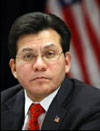
Gonzales doesn't satisfy critics - GOP or Dems
Legal Business |
2007/04/20 11:10
|
| The Bush White House called embattled Attorney General Alberto Gonzales "our No. 1 crime fighter" Friday, a day after Gonzales' often halting explanations for the firings of eight federal prosecutors brought additional demands for his resignation. "He has done a fantastic job in the Department of Justice," deputy press secretary Dana Perino told reporters traveling aboard Air Force One as President Bush headed for a speech in Michigan. Gonzales had gone to Capitol Hill Thursday with just one mission: to placate Republican and Democratic senators dissatisfied with his account of how eight federal prosecutors were fired. Apparently, he failed. For the first time, Republicans on the Judiciary Committee broke ranks and said it might be best if Gonzales stepped down. "It is generous to say the attorney general's communications about this matter have been inconsistent," Sen. Tom Coburn, R-Okla., told Gonzales in a packed hearing room Thursday. "The consequence should be the resignation of the attorney general." Sen. Jeff Sessions, R-Ala., said in an interview after the hearing, "There are some problems that he just hasn't handled well, and it might just be best if he came to a conclusion that the department is better served if he's not there." Some of the committee's biggest questions went unanswered: How exactly did the Justice Department settle on the eight prosecutors who were fired? Does Gonzales have command of his agency? "You have been a forceful witness, and you have had a lot of staying power," Sen. Arlen Specter, the ranking Republican on the committee, said near the end of Gonzales' seven hours of testimony. "But we haven't gotten, really, answers," added Specter, R-Pa. "I urged you to put on the record the details as to all the U.S. attorneys you asked to resign so that we could evaluate. And you have not done that." Specter threw Gonzales a thin lifeline, declining to call for his resignation but making it clear that he thinks there's little argument for Gonzales keeping his post. "His ability to manage the department has been severely undercut by the way he has handled these resignations and by the way he has handled his news conferences, his press statements and his testimony before the committee," Specter said.
|
|
|
|
|
|
|
AG Gansler won't appeal Fair Share Health Care case
Legal Business |
2007/04/18 09:13
|
| Maryland Attorney General Douglas F. Gansler said Tuesday that Maryland will not challenge a decision by the US Court of Appeals for the Fourth Circuit holding that the federal Employee Retirement Income Security Act (ERISA) preempts the Maryland Fair Share Health Care Fund Act. The act was part of a state attempt to force Wal-Mart to contribute more for employee health care. In a 2-1 ruling in January, the court upheld a district court ruling which determined that the Maryland law violates ERISA by not allowing Wal-Mart to create a uniform employee health benefit program nationwide. Maryland is now planning to look to other states as models, such as Massachusetts. The Massachusetts health care plan includes a private insurance exchange and requires that businesses help pay for the system. The Maryland law would have required companies with more than 10,000 employees to spend at least eight percent on employee health care, or pay the difference of that amount into the state Medicaid fund. The Retail Industry Leaders Association (RILA), of which Wal-Mart is a member, filed a challenge to the health care law last year, arguing that the law is preempted by the federal ERISA, and that the law violates the equal protection clause of the constitution. |
|
|
|
|
|
|
Law firm gives Washburn students insight
Legal Business |
2007/04/14 13:51
|
Winton Hinkle can't keep up with the demand for transactional attorneys at his Wichita firm, Hinkle Elkouri Law Firm LLC. It's a legal art, his attorneys say, building a large transaction puzzle out of tiny, detailed pieces. Leave one out, and the deal crumbles. That's one big reason Hinkle and his partners pitched the merits of business law, Wichita and their firm Friday to a group of 20 Washburn Law School students. The day-long seminar, "Anatomy of a Business Transaction," gave the lawyers-to-be a hands-on look at how Hinkle Elkouri would handle the sale of a fictional business. Washburn professor David Pierce brought his students to Wichita to translate the classroom tenets he teaches into the world of business buying and selling. And for Hinkle, it was an opportunity for nine attorneys on his business sales team to interact with -- and recruit -- prospective new attorneys. "The business is growing," he said. "We find ourselves adding one or two attorneys every year. It's pretty competitive, and we think this is a great chance to pitch Wichita to them." It's Pierce's first venture into a day in the life of a law firm. "Our students get a view of how what they're learning in the classroom is applied in a major legal practice," he said. "And they get to see first-hand how complicated the practice of business law actually is." The Hinkle Elkouri attorneys spent the day outlining those detailed little pieces to the business sales puzzle -- from preliminary agreement issues to due diligence and the issues a buyer faces as it assumes employees. And in the middle, they heard from Hinkle Elkouri client C.R. Hall, owner of Hall's Culligan Water, on how a business owner interacts with his attorneys. The upshot: Handling a business deal is a detailed business. "It's absolutely critical for you to get as much information as possible about the company you're buying," attorney Donna Bohn, a former Koch Industries transactional attorney, told the students. "I'm always amazed how much information there is on the Internet." But there's more: Company assets have to be catalogued, as do personal property and machinery. Business inventory is a separate issue, rarely included in the purchase price because valuation is impossible until closing. And the purchase price can remain on the table until the moment of closing. It was enough to leave third-year law student Jeremy Atwood's head spinning. "What really stands out to me are the number of things to consider that I'm going to have to understand," he said. "You can listen to lectures," said second-year law student Amber Whitlock. "This is a great first-hand look at what we're learning in action." There will be more class trips into the real world, Pierce said.
|
|
|
|
|
|
|
Class action or a representative action is a form of lawsuit in which a large group of people collectively bring a claim to court and/or in which a class of defendants is being sued. This form of collective lawsuit originated in the United States and is still predominantly a U.S. phenomenon, at least the U.S. variant of it. In the United States federal courts, class actions are governed by Federal Rules of Civil Procedure Rule. Since 1938, many states have adopted rules similar to the FRCP. However, some states like California have civil procedure systems which deviate significantly from the federal rules; the California Codes provide for four separate types of class actions. As a result, there are two separate treatises devoted solely to the complex topic of California class actions. Some states, such as Virginia, do not provide for any class actions, while others, such as New York, limit the types of claims that may be brought as class actions. They can construct your law firm a brand new website and help you redesign your existing law firm site to secure your place in the internet. |
Law Firm Directory
|
|


 Legal News RSS Feed