|
|
|
Canada's East Coast seal hunt opens quietly
Environmental |
2007/04/02 08:51
|
Canada's controversial annual seal hunt opened Monday in the southern Gulf of St. Lawrence, where the worst ice conditions in more than two decades have nearly wiped out the herd. Fisheries officials said they expect only a few boats from the Maritime provinces will take part in the first phase of the centuries-old hunt. About 40 boats from Nova Scotia, New Brunswick and Prince Edward Island are eligible, with most of the early hunting focused on the Cape Breton coast, said Fisheries Department spokesman Roger Simon. "There are a few seals scattered from Sydney towards Canso but they are very sparse and the ice is broken and deteriorated," he said. "What seals were in that area may be swimming back north and we know a higher proportion drowned this year. The bad ice contributed to a high rate of drowning," Fisheries Department spokesman Phil Jenkins said. "The mortality from bad ice is going to be fairly high." The hunt is key to the livelihood of Canadian fishermen and aboriginal peoples. To protect the seal population in Canada — which now stands at about 5.5 million - fisheries officials announced a sharp reduction in the number that can be killed. |
|
|
|
|
|
|
LA wtnesses driest year due to global warming
Environmental |
2007/04/01 08:44
|
Los Angeles got just a half-inch of rain this month, indicating that the city was experiencing the driest rain year on record, the National Weather Service reported Sunday. The .05 inches that fell in March is more than 3 inches below the average March rainfall of 3.14 inches. This rain season, which begins in July, is currently the driest downtown since records began to be kept in 1877, according to the Weather Service. This was largely due to global warming which pushes up temperatures and leads to rising sea levels, said scientists. Since July 1, downtown has received just 2.47 inches of rain --nearly a foot, or 11.47 inches below the normal precipitation to date, which is 13.94 inches. To date, only 18 percent of normal rainfall has fallen. If downtown receives less than 1.95 inches of rain through June 30, it will become the driest rain season ever for the area, beating the 4.42 inches of rain that fell in 2001-02. Average rainfall begins to drop off sharply in Los Angeles in April, when the average is .83 inches. In May, average rainfall drops to .31 inches, and .06 inches in June. Los Angeles averages 15.14 inches of rain a year. |
|
|
|
|
|
|
Lawsuit filed over sludge compost plant
Environmental |
2007/03/30 03:52
|
Environmentalists and Hinkley residents have filed a lawsuit to stop an open-air sewage sludge composting plant from being built near that town, made famous by the move "Erin Brockovich." The lawsuit filed yesterday against San Bernardino County alleges that supervisors approved the plant without fully analyzing its potential impact on air quality and public health. The suit also contends that the project doesn't adequately protect the threatened desert tortoise and the Mojave ground squirrel. The groups behind the suit say they're not trying to stop the plant. They say they just want to force the county to enclose it and filter its odors. But officials with Nursery Products, the company building the plant, says that option is too expensive and that the county did a thorough job in evaluating the open-air project when it cleared its construction. |
|
|
|
|
|
|
Ban on plastic bags likely to become law
Environmental |
2007/03/28 02:14
|
City leaders approved a ban on most plastic grocery bags after weeks of lobbying on both sides from environmentalists and a supermarket trade group. If Mayor Gavin Newsom signs the ban as expected, San Francisco would be the first U.S. city to adopt such a rule. The law, passed by a 10-1 vote, requires large markets and drugstores to give customers only a choice among bags made of paper that can be recycled, plastic that breaks down easily enough to be made into compost or reusable cloth. |
|
|
|
|
|
|
Debate focuses on global warming law
Environmental |
2007/03/27 15:40
|
| California lawmakers expressed skepticism Monday about how the Schwarzenegger administration plans to reduce greenhouse gases, illustrating the difficulty in implementing the state’s much publicized global warming law. Democrats questioned why the state planned to spend millions of dollars on mechanisms that have yet be evaluated or clearly defined. “A lot of the language we’re using here is very fuzzy,” said Assemblywoman Loni Hancock, D-Berkeley, chair of the Assembly Natural Resources Committee. “I think we really need to develop something that all of the public understands.” The committee held the Legislature’s first public hearing on how to implement the greenhouse gas reductions called for in the law, which was signed with great fanfare last year by Gov. Arnold Schwarzenegger. It imposes the country’s first statewide cap on emissions of the heat-trapping gases that are blamed for global warming. The law requires California to reduce emissions by an estimated 25 percent by 2020 – an estimated 174 million metric tons. The California Air Resources Board, which was charged with implementing the law, has begun hearings and workshops to sort out how much the state must reduce its emissions and what industries will be asked to do. The board is considering a variety of strategies, including creating new regulations for fuels and creating a market that would allow companies to buy and sell credits to meet their obligations under the law, commonly referred to as Assembly Bill 32. “This is a critical moment,” said Ira Ruskin, D-Redwood City. “Implementing AB32 is probably a task equally important as passing AB32. We have to set the right tone for the coming years.” The law is one of the key ways California lawmakers are seeking to limit global climate change. Scientists and experts in various state agencies predict climate change could diminish California’s water supply, stress farm land and forests, and alter the coast line as sea levels rise. |
|
|
|
|
|
|
Gore: No Time Left on Global Warming
Environmental |
2007/03/22 09:05
|
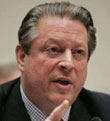
| Al Gore returned Wednesday to packed crowds in the halls of power, offering ideas on how to reduce global warming that were met with skepticism from some of his former Republican colleagues. The former vice president, whose global-warming documentary An Inconvenient Truth won two Oscars last month, demanded that lawmakers "show courage" by taking dramatic steps to curb changes in the Earth's climate. Among the steps Gore suggested: a ban on incandescent light bulbs and a freeze on the USA's yearly emissions of gases linked to global warming. "We do not have time to play around with this," Gore warned several dozen members of the House science and energy committees. "We do not have the luxury of playing political football." He called the situation a "planetary emergency." Rep. Joe Barton, R-Texas, whose district includes oil and manufacturing interests, challenged Gore on whether carbon dioxide emissions cause global warming. Barton vented some of his displeasure at Gore's remarks by reading a newspaper as Gore talked. Many scientists agree the Earth is warming because of "greenhouse gases" being added to the atmosphere by human activity. The most common greenhouse gas is emitted when fuels such as gasoline and coal are burned. Some scientists say the Earth has been warming naturally. Banks of TV cameras whirred and dozens of photographers clicked away as Gore testified. Reporters and onlookers were packed into overflow rooms for his first Capitol Hill appearance since 2001. At that time, the failed Democratic presidential candidate, in his capacity as Bill Clinton's vice president, presided over the Senate as it counted electoral votes from the 2000 election. Gore made no mention of the 2008 presidential campaign. Some polls show he would be among the top contenders if he were to run for his party's presidential nomination. Former House speaker Dennis Hastert, R-Ill., referred to Gore as a "movie star" and said he agreed with Gore that the debate over the science of global warming has been settled. Gore's longtime concerns about global warming "really do make you look like a prophet," said Rep. Ed Markey, D-Mass., head of a new House committee on global warming. "It would be wise for the Congress to listen to your warnings, because history has borne you out." In the afternoon, it was senators' turn to listen to Gore, who compared global warming to the devastation after World War II. "Now this generation and this Senate faces such a challenge," Gore told the Senate Environment and Public Works Committee. "The stakes are high, but the people are hopeful, and it can be done." Sen. James Inhofe, R-Okla., sparred a little with Gore, asking him to promise that Gore's large Nashville home will use no more energy than the average American home. Inhofe once declared global warming "the greatest hoax ever perpetuated on the American people." Gore declined to make that pledge, saying he pays extra for electricity from sources such as wind power, which emits no greenhouse gases. "In terms of changing the way you live," Inhofe said, "I think it's very difficult for you to ask other people to do it unless you're willing to do it." |
|
|
|
|
|
|
Navy refuses sonar details in whale lawsuit
Environmental |
2007/03/21 08:33
|
The US Navy on Tuesday played its "state secrets" joker in ongoing attempts to resist a whale-saving lawsuit by an environmental group. The group bringing the lawsuit, the Natural Resources Defence Council (NRDC), believes high-powered naval sonar can distress, injure, or kill whales and dolphins. It is also suggested that active sonar pulses can disorient cetaceans and cause them to become stranded or lost. Secretary for the Navy Donald Winter said in a court filing that the plaintiffs' requests for disclosure, if complied with, "could reasonably be expected to cause exceptionally grave damage to national security". According to the Navy, the conservationists had requested information on the latitude, longitude, time and date, duration, and name of the exercise for every non-combat use of military sonar by the US Navy anywhere in the world. The NRDC describes itself as "the US nation's most effective environmental action organisation", and it doesn't intend to let the navy get away with the state secrets ploy. |
|
|
|
|
|
|
Class action or a representative action is a form of lawsuit in which a large group of people collectively bring a claim to court and/or in which a class of defendants is being sued. This form of collective lawsuit originated in the United States and is still predominantly a U.S. phenomenon, at least the U.S. variant of it. In the United States federal courts, class actions are governed by Federal Rules of Civil Procedure Rule. Since 1938, many states have adopted rules similar to the FRCP. However, some states like California have civil procedure systems which deviate significantly from the federal rules; the California Codes provide for four separate types of class actions. As a result, there are two separate treatises devoted solely to the complex topic of California class actions. Some states, such as Virginia, do not provide for any class actions, while others, such as New York, limit the types of claims that may be brought as class actions. They can construct your law firm a brand new website and help you redesign your existing law firm site to secure your place in the internet. |
Law Firm Directory
|
|


 Legal News RSS Feed